


TIC in Focus: Consolidation, Valuation Logic, and M&A Dynamics in Germany
The German TIC market is one of the structurally most attractive consolidation fields for medium-sized businesses. Testing, Inspection & Certification is a regulatory requirement in many industries, creating demand that is significantly less dependent on economic cycles than in classic B2B markets. Recurring inspection cycles, re-certifications, and audits also ensure predictable revenues and high customer loyalty.
Accredited specialists with high technical depth, robust certifications, and clear positioning in regulatory growth fields are particularly in demand. These include industrial testing, energy and infrastructure, life sciences, cybersecurity, and advanced testing. The decisive factor is not so much the breadth of the offering as the question of how difficult it is to replicate expertise, accreditation, and customer relationships.
At the same time, consolidation is noticeably picking up speed. Strategic investors and PE-backed platforms are specifically expanding their market position through acquisitions. The still fragmented market offers good conditions for this, especially for specialized providers with recurring revenues and buy-and-build potential.
Our M&A report classifies the market structure, regulatory drivers, current deal motives, and the valuation logic of the sector. Valuation premiums arise primarily where stable cash flows meet high barriers to entry, specialization, and technological competence.
Receive the complete M&A report on TIC in Germany with in-depth analysis of market structure, deal activity, consolidation clusters, valuation logic, and strategic implications.
Request the full M&A report now.
What is TIC in Germany?
Testing, Inspection & Certification includes testing, inspection, audit, and certification services along industrial, technical, and regulatory value chains. These include, among others:
• Product testing and evaluation
• Inspection and audit services
• Certification and conformity assessment
• ESG and compliance audits
• Cybersecurity and digital testing services
• Calibration, metrology, and specialized laboratory services
The German TIC market is strongly characterized by SMEs. Many providers possess deep technical specialization, long-standing customer relationships, and accreditations that are difficult to replicate. It is precisely this combination that makes good TIC companies attractive to buyers: recurring inspection cycles create predictable revenues, regulatory recognitions limit competition, and switching customers is often associated with considerable effort.
Why the TIC Market is Becoming Strategically Relevant Now
The demand for independent testing and certification is not rising solely with industrial activity. It is increasingly determined by regulation, rising safety requirements, and new technological demands.
Several developments are therefore bringing TIC more into the focus of strategic buyers and financial investors:
• increasing regulatory reporting obligations
• higher requirements for product and cybersecurity
• growing importance of ESG and assurance
• technological complexity in industry and infrastructure
• shortage of skilled workers for high-quality testing services
• rising demand for local technical expertise
CSRD, NIS2, EU AI Act, and the new Machinery Regulation create additional testing and verification requirements. At the same time, market entry remains challenging for new providers because accreditations, technical expertise, and official recognitions cannot be built up in the short term.
Testing, Inspection & Certification at a Glance
The TIC market can be divided into several segments, which exhibit different growth and valuation profiles:
• Industrial and Manufacturing Testing: Quality, material, and production testing
• Infrastructure, Energy, and Construction: Technical inspections and safety-relevant tests
• Life Sciences: Pharma, MedTech, and food safety
• Specialized Testing: Aerospace, cybersecurity, ESG, and advanced testing
• Certification and Audit: Regulatory and standards-based verification services
• Calibration and Metrology: Measurement, testing, and calibration services
The decisive factor is not so much the pure breadth of the service portfolio as the positioning within the respective end market. The more strongly regulatory requirements, technical specialization, and accreditation interact, the higher the barriers to entry regularly are.
How the Market is Structured
The German TIC market is fragmented, but at the same time strategically easy to read. Two axes are particularly relevant from an M&A perspective: specialization and portfolio breadth, as well as proximity to the classic TIC core market.
Four groups of providers can be derived from this:
• Specialized TIC providers with high technical depth
• Broad TIC platforms with multiple testing and certification fields
• Specialists in adjacent technical markets
• Platforms that combine TIC services with complementary services
Accredited specialists in regulatory growth fields as well as platforms with recurring mandatory revenues and a clear buy-and-build perspective are particularly attractive. Around 6,400 DAkkS-accredited laboratories also illustrate how finely structured the market remains.
In the full report: the market structure matrix with classification of relevant providers and strategic positioning fields.
M&A Trends in the German TIC Market
M&A activity follows a clear pattern: strategic buyers expand their technical competence and regional presence, while financial investors consolidate fragmented submarkets through platform strategies.
Recent transactions show that accredited niche competencies are in high demand. Acquisitions are taking place in wind energy, occupational safety, non-destructive testing, micromobility, nuclear services, environmental analysis, as well as calibration and metrology. It is often less about pure size than about access to specialist personnel, certifications, and specialized testing capacities.
Buyer demand essentially comes from three directions: global TIC groups, PE-backed platforms, and industry- and infrastructure-related providers looking to expand their position along critical technical assets.
In the full report: the current deal overview, relevant consolidation clusters, as well as strategic and financial buyer logics.
Valuation Logic for TIC Companies
TIC is not a uniform valuation market. The decisive factor is which end market a company operates in and how difficult its service is to replace for the customer.
Particularly relevant are:
• Share of recurring revenues
• Customer concentration
• Depth of accreditation and certification
• Technical specialization
• Regulatory relevance of the service
• Scalability and platform capability
Indicative valuation ranges vary by segment from around 6x EBITDA for classic industrial testing to 12x to 16x EBITDA for highly specialized testing services. Life Sciences typically moves in the range of around 10x to 14x EBITDA. The decisive factor for a valuation premium is the combination of stable cash flows and a market position that is difficult to replicate.
In the full report: indicative valuation ranges by TIC archetype and the central value drivers.
Role of Regulation, Accreditation, and Technological Specialization
Regulation is not a side aspect in the TIC market, but a substantial part of the demand base. New requirements increase the need for testing and at the same time the value of established providers.
Particularly relevant at present are:
• CSRD and external assurance
• NIS2 and KRITIS requirements
• EU AI Act and conformity requirements for high-risk AI
• Machinery Regulation and product safety
• Increasing cybersecurity requirements
Accreditations act like a protective wall. Existing providers can expand their scope, while new market participants must first build up recognitions, processes, and competence. It is precisely this structural scarcity that makes specialized TIC providers interesting for strategic buyers and platform investors.
What the Full Report Shows
The report shows how the German TIC market is structurally changing and which provider profiles are becoming particularly relevant in the ongoing consolidation.
Insights from the report:
• Central market thesis on the German TIC sector
• Regulatory and structural growth drivers
• Market structure and classification of relevant providers
• Current transactions and deal motives
• Indicative valuation ranges by asset type
• Commercial and strategic value levers
The complete analysis with market structure matrix, deal overview, valuation logic, and strategic value drivers is included in the full report.
Frequently Asked Questions about TIC and M&A
What is meant by TIC?
TIC stands for Testing, Inspection & Certification and includes independent testing, inspection, and certification services. Providers support companies with product safety, quality, regulatory compliance, and technical verification obligations.
Why is the TIC market in Germany consolidating?
The market remains highly fragmented, while regulatory requirements and technological complexity are increasing. Strategic buyers and PE platforms use acquisitions to build up accreditations, specialized skills, qualified personnel, and regional presence faster than through organic growth.
How are TIC companies valued?
The end market, recurring revenue, depth of accreditation, customer loyalty, and specialization are decisive. The more difficult a provider is to replace and the more stable its cash flows are, the higher the valuation typically is. Indicative EBITDA multiples range from about 6x to 16x depending on the segment.
Which TIC companies are attractive M&A targets?
Accredited specialists in regulatory growth fields, providers with high recurring revenues, and companies that can be integrated as add-ons into existing testing and certification platforms are in high demand.
Which M&A trends are shaping the German TIC market?
Strategic buyers are broadening their service offering and regional presence. Financial investors are pursuing buy-and-build strategies in fragmented submarkets. There is particularly high activity where technical specialization meets regulatory-backed demand.
What makes a TIC provider difficult to replace?
Accreditations, official recognitions, technical know-how, and historically grown testing processes cannot be replicated in the short term. Added to this are recurring certification and inspection cycles as well as high switching costs on the customer side.
Why is TIC interesting for investors?
TIC combines several characteristics that strategic buyers and financial investors seek: recurring revenues, regulatory-backed demand, high barriers to entry, and a still fragmented market. A company becomes particularly attractive when stable cash flows come together with technical or regulatory competence that is difficult to replicate.
Would you prefer a direct exchange? Mary Ghebretinsae will be happy to personally support you with a confidential discussion for further classification.
T: +49 (0) 2150 7058 210
Related Posts



July 7, 2026
GovTech in Germany: M&A Report on Public Sector Tech, Municipal Software, and Administrative Software
How the market for IT & software in public administration is being reshaped –…

July 1, 2026
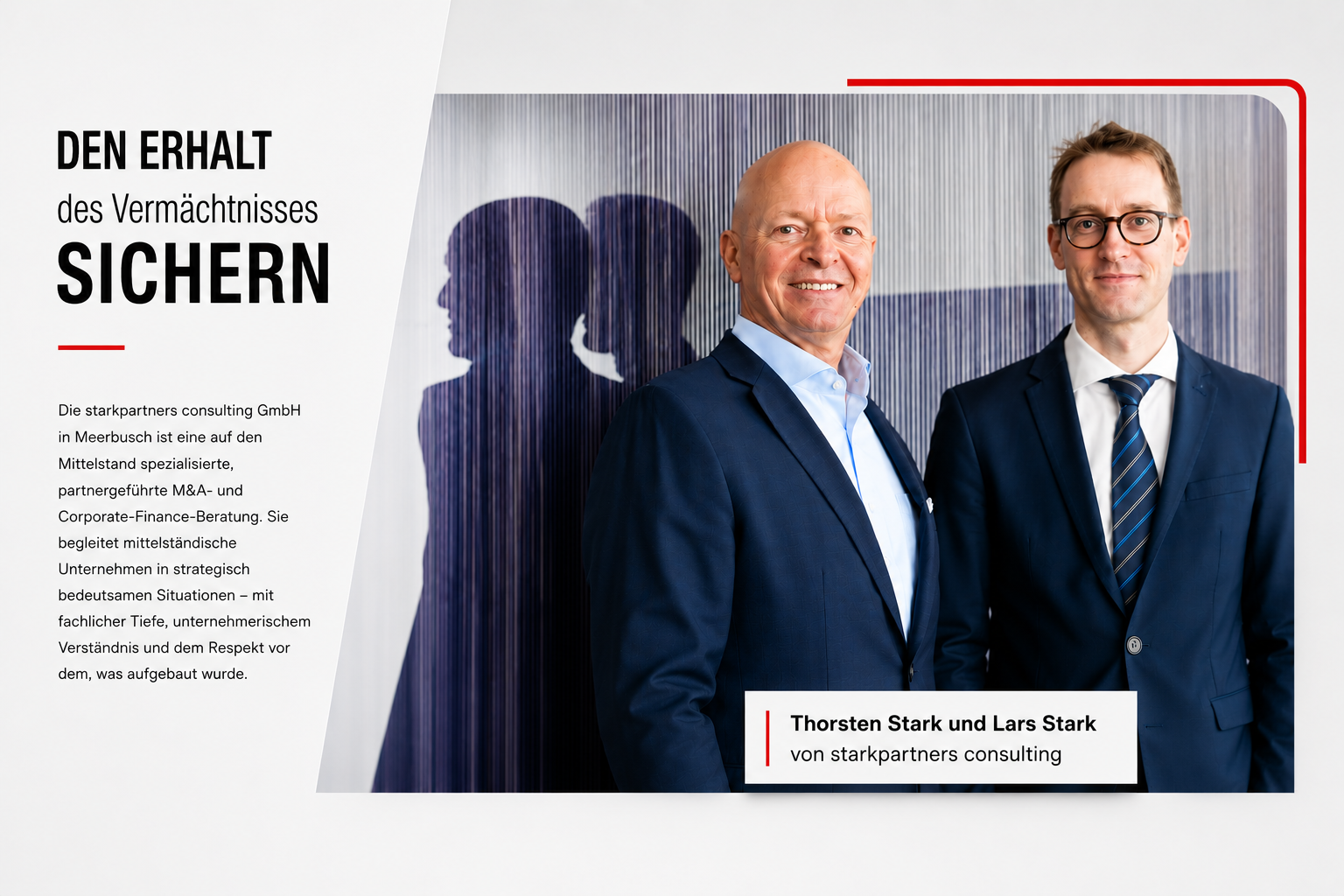
Securing the Preservation of a Legacy
starkpartners consulting in the magazine "Standort Meerbusch" - We support…